
Country Profiles
Nigeria
 Nigeria
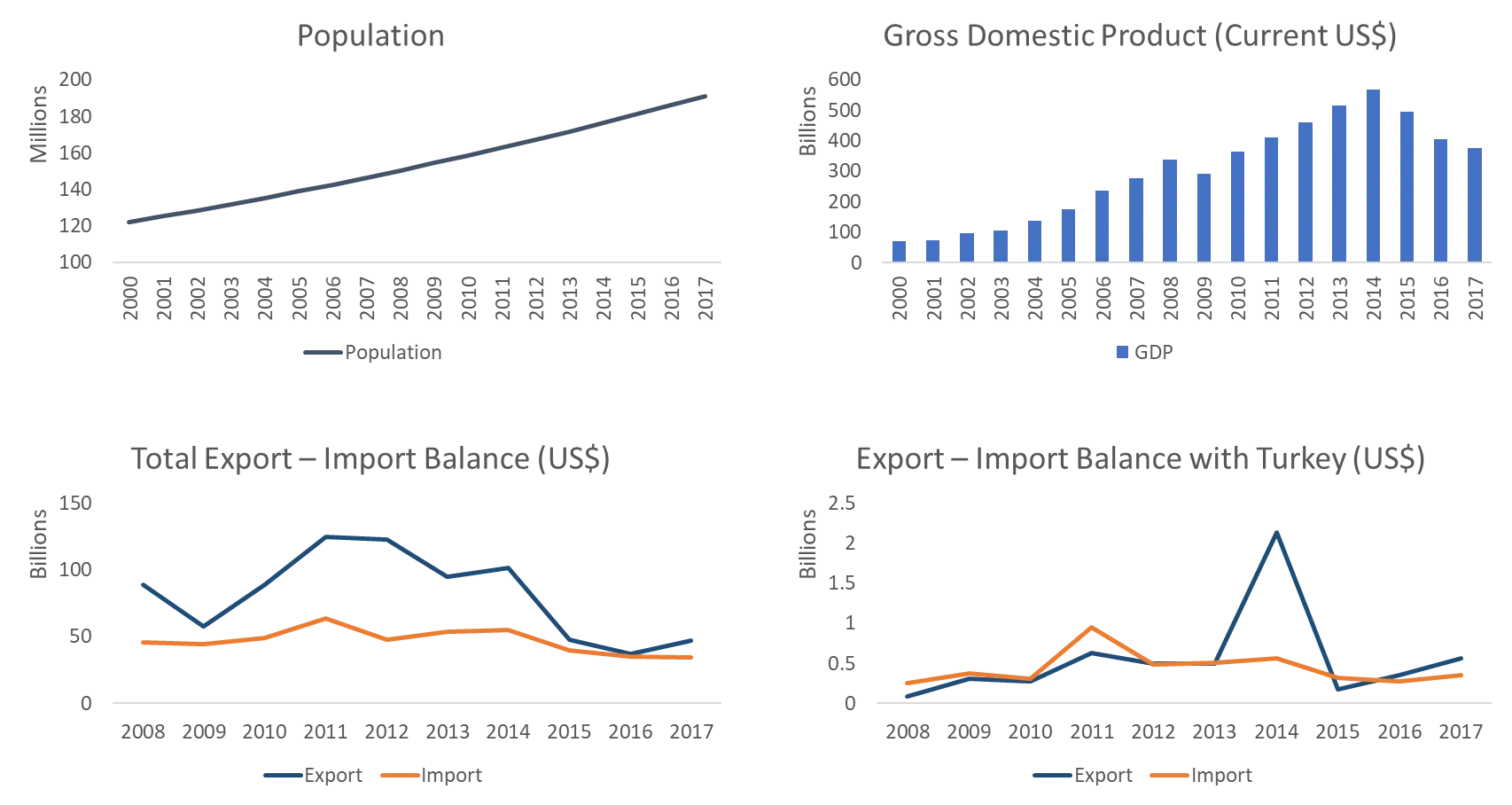
The Federal Republic of Nigeria is located in West Africa. It is bordered by Cameroon, Niger, Chad and Benin. Nigeria is referred as the `Giant of Africa’, due to its strong economy and large population. Its population reached 191 million in 2018 and Nigeria has the highest GDP in Africa with $375 Billion. Nigeria overtook South Africa in 2014 to become Africa’s largest economy. Nigeria is a member of African Union, United Nations, OPEC and Commonwealth.
Nigeria gained independence in 1960 from the United Kingdom. The official language of the country is English and its capital is Abuja. However, the biggest city and the industrial hub of Nigeria is Lagos. The population of Lagos is more than 20 million. Nigeria’s economy boomed thanks to oil industry. However, the economy of Nigeria is heavily dependent on oil price fluctuations.
China is the most important trade partner of Nigeria. Whereas, Nigeria exports most of its crude petroleum to India and USA. Nigeria has a positive trade balance, it exports more than it imports. However, the trade balance deteriorated due to decreasing oil price in the last years.
Turkey and Nigeria has diplomatic relations since the independence of Nigeria. Turkey opened an Embassy in Lagos, previous capital of Nigeria, in August 1962. Turkish businesses can find important opportunities in Nigeria thanks to its large and diversified economy. Manufacturing and food companies can use Nigeria as a hub to expand to other West African countries. The exports of Turkey to Nigeria are concentrated in industrial goods and agricultural products. Especially, processed iron is an important export good from Turkey to Nigeria.
Below, you can see the fact sheet, macroeconomic outlook and trade relations of Nigeria with Turkey.
Country at a glance
- Capital city
- Abuja
- Official language
- English
- Population
- 191 million
- GDP
- $375 billion
- GDP per capita
- $1,969
- Human Development Index
- 0.532
- Top 3 import partners
- China, Belgium, Netherlands
- Top 3 export partners
- India, USA, Spain
- Top 3 import products
- Refined Petroleum, Ships, Wheat
- Top 3 export products
- Crude Petroleum, Petroleum Gas, Cocoa
- Trade balance
- +$12.7B in net exports
Source: Istanbul Africa Trade Company, Africa Economic Report (2019). Figures as published, reflecting data to 2017.
Nigeria: practical trade guide
What a shipment between Turkey and this market needs, how the goods get there, and what to settle before you sign.
- Main ports
- Lagos (Apapa, Tin Can Island), Lekki Deep Sea Port, Onne, Port Harcourt
- Currency
- Nigerian naira (NGN)
- Trade blocs
- AfCFTA, ECOWAS
- Trade agreement with Turkey
- None in force: standard duties generally apply
Specific to Nigeria
- The Nigerian importer opens a Form M through an authorised bank before the goods ship.
- Products regulated by the Standards Organisation of Nigeria need SONCAP certification; food, medicines, cosmetics and chemicals need NAFDAC registration.
Access to foreign exchange has been tight at times: confirm how and when the buyer will pay before production starts.
Standard documents
- Commercial invoice and packing list
- Bill of lading or air waybill
- Certificate of origin issued by a Turkish chamber of commerce
- Insurance certificate when the Incoterm includes insurance (CIF, CIP)
Before you sign
- Check the counterparty: registration, activity and references
- Match the payment structure to the risk: advance or partial payment, documentary collection or a letter of credit
- Confirm whether your product needs a certificate or registration in this market before production starts
Reviewed October 2026. Requirements change: confirm the current rules for your product with your forwarder, the buyer's customs broker or us before shipping.
Turkey's exports to this market
Source: Istanbul Africa Trade Company, Africa Economic Report. Figures as published.
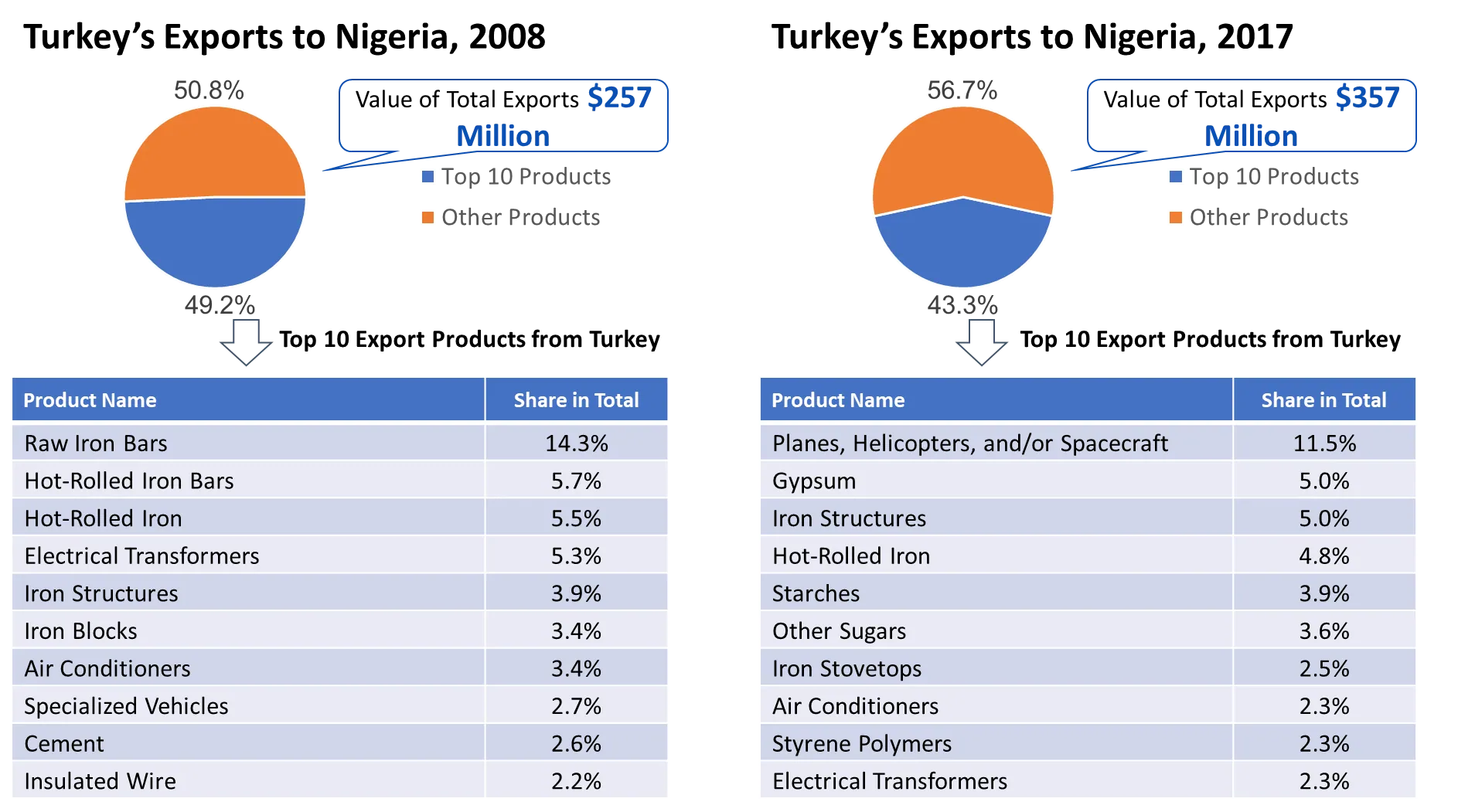
2008
$257 million
Top 10 products account for 49.2% of the total.
| Product | Share of total |
|---|---|
| Raw Iron Bars | 14.3% |
| Hot-Rolled Iron Bars | 5.7% |
| Hot-Rolled Iron | 5.5% |
| Electrical Transformers | 5.3% |
| Iron Structures | 3.9% |
| Iron Blocks | 3.4% |
| Air Conditioners | 3.4% |
| Specialized Vehicles | 2.7% |
| Cement | 2.6% |
| Insulated Wire | 2.2% |
2017
$357 million
Top 10 products account for 43.3% of the total.
| Product | Share of total |
|---|---|
| Planes, Helicopters, and/or Spacecraft | 11.5% |
| Gypsum | 5% |
| Iron Structures | 5% |
| Hot-Rolled Iron | 4.8% |
| Starches | 3.9% |
| Other Sugars | 3.6% |
| Iron Stovetops | 2.5% |
| Air Conditioners | 2.3% |
| Styrene Polymers | 2.3% |
| Electrical Transformers | 2.3% |
Frequently asked questions
- Nigeria: what does Turkey export there?
- In 2017, Turkey's exports to this market were valued at $357 million. The ten largest product groups made up 43.3% of that total, led by Planes, Helicopters, and/or Spacecraft; Gypsum; Iron Structures.
- Nigeria: who are its main trading partners?
- The three largest import partners are China, Belgium, Netherlands. The three largest export partners are India, USA, Spain.
- Nigeria: what does the country import?
- The three largest import products are Refined Petroleum; Ships; Wheat. The three largest export products are Crude Petroleum; Petroleum Gas; Cocoa.
- Nigeria: how big is the economy?
- Population 191 million, GDP $375 billion, and $1,969 per person. The Human Development Index is 0.532.
- Nigeria: does it run a trade surplus or a deficit?
- The trade balance is +$12.7B in net exports.
- Nigeria: which ports handle goods from Turkey?
- The main ports are Lagos (Apapa, Tin Can Island), Lekki Deep Sea Port, Onne, Port Harcourt.
- Nigeria: what does a shipment from Turkey need beyond the standard documents?
- The Nigerian importer opens a Form M through an authorised bank before the goods ship. Products regulated by the Standards Organisation of Nigeria need SONCAP certification; food, medicines, cosmetics and chemicals need NAFDAC registration.
- Nigeria: do Turkish goods get a preferential duty rate?
- Not under a bilateral agreement: Turkey's free trade agreements in force in Africa cover Morocco, Tunisia and Egypt. Standard duties generally apply, and AfCFTA preferences cover goods of African origin, not Turkish goods.
Related reading
Exporting from Turkey to Nigeria: A Step by Step Guide
Exporting from Turkey to Nigeria, step by step: the documents, buyer verification, shipping and customs clearance a first shipment needs, and who...
Import from Turkey to Nigeria Guide
Importing from Turkey to Nigeria presents a golden opportunity for businesses looking to expand.

Turkish Construction Materials in Africa: A Seller's Guide
A practical look at selling Turkish construction materials in Africa: the products that sell, the markets that buy them, what the 2017 trade data...
- How to Start Exporting from Turkey to Ivory Coast: A Practical Guide
- Success Stories of Turkey-Africa Trade Partnerships
- Why Africa is Turkey’s New Trade Hub
- Business Setup in Turkey for African Investors
- How to Build an Export Business in Africa
- Fruits and Vegetables Export from Africa to Turkey
- Turkish Ceramic and Tile Export to Africa
- Best African Countries for Turkish Exporters
- Exporting Home Appliances to Africa
Other country profiles
- Buying from Turkey for Nigeria?How we find and check Turkish manufacturers and secure your terms before you pay.For African importers
- Exporting from Turkey to Nigeria?Exporting from Turkey to Nigeria: A Step by Step GuideRead the route guide
Reviewed by Burak Unal, Director of African Markets