Green Coffee Contract Terms for Turkish Coffee Roasters
A plain guide to green coffee contract terms for Turkish roasters: quality specs, grading, sampling, Incoterms and payment, and who decides what at...
· 10 min read
Written by Burak Unal, Director of African Markets
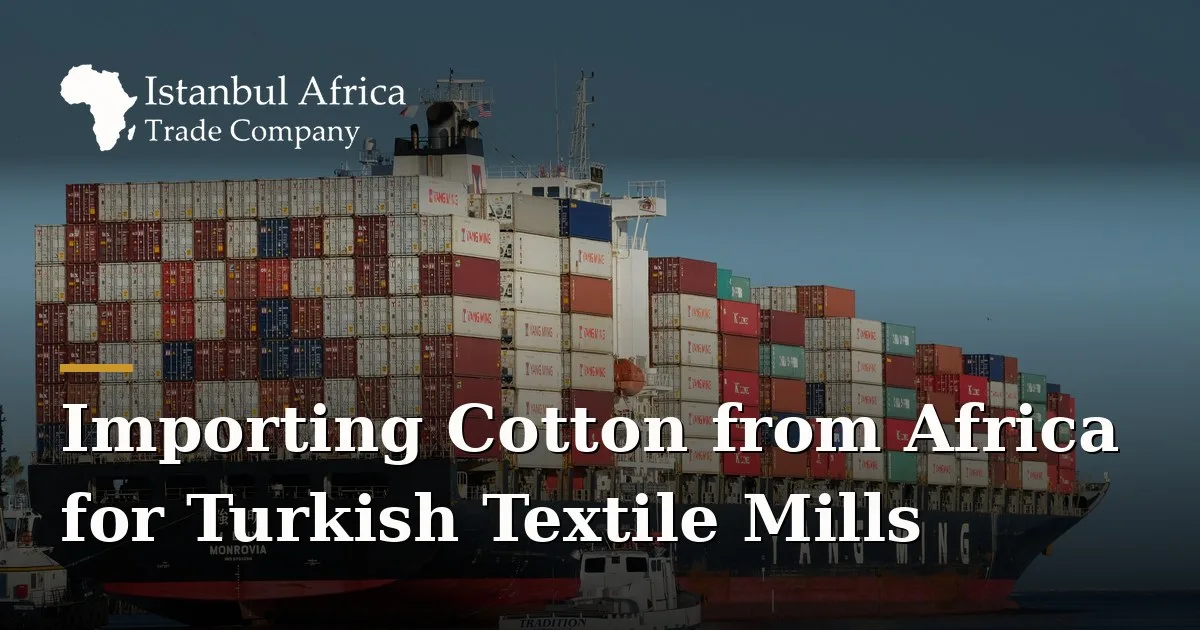
Importing cotton from Africa is a route more Turkish textile mills are examining as they look to widen where their raw fibre comes from and to shorten the line between the field and the spinning frame. By the end of this guide you will know where the main African cotton origins sit, how to find and check a seller, what paperwork a raw cotton shipment involves, and which decisions rest with you and which rest with the authorities.
Turkey runs one of the larger textile and apparel industries in its region, and it does not grow enough lint at home to feed every mill. That gap is why African cotton for textile mills is worth a serious look. The continent grows cotton across a wide band, from the long-staple crop of the Nile valley to the rain-fed cotton of East and West Africa, and several of those origins sit within a reasonable sea distance of Turkish ports.
This is a buyer's guide and not a promise. We advise on the sourcing and the checks; the price, the contract and the customs treatment are settled by you, the seller and the relevant authorities. Where a figure matters to your decision, confirm it against a current, named source before you act on it.
Turkish mills look to Africa because the continent is a large, nearby grower of cotton at a time when spinners want more than one origin on their books. Relying on a single source leaves a mill exposed when that one crop fails or that one government changes its export rules. African cotton for textile mills offers a second or third origin that is geographically close, which matters for both freight time and the cost of holding stock.
There is a commercial logic underneath the geography. A spinner that can switch between origins negotiates better and plans production with fewer surprises. In our experience advising buyers, the mills that handle a bad season calmly are the ones that qualified a second origin a year before they needed it, not the week the first one ran short.
The main African cotton origins fall into three broad groups: the Nile valley, East Africa, and West Africa. Egypt is the best known name, associated with long-staple cotton; Sudan grows cotton along the same river system. In East Africa, Tanzania and Uganda are long-standing growers, and you can read more about one of them on our Tanzania country profile. West Africa produces a large rain-fed crop across several landlocked countries that ship through coastal ports.
Each origin has its own character. Nile valley cotton is prized for staple length and commands a premium; East and West African cotton is more often a medium-staple, volume crop. Egypt also sits in Turkey's trade orbit already: as of 2017, the last year covered by our Africa Economic Report, Egypt counted Turkey among its top three export partners, which tells you the commercial channels between the two countries are not new. For current production and export volumes, check a named body such as the International Cotton Advisory Committee rather than any figure quoted second hand.
You find raw cotton suppliers in Africa through the ginners and the recognised marketing channels of each origin, then you verify each one before any money moves. Many African crops are sold through structured systems, from auctions to licensed ginners and marketing boards, so the first job is to learn how the specific origin actually sells its lint. Starting from the wrong channel is how buyers end up talking to a broker with no cotton behind him.
Verification means confirming that the seller exists, controls the cotton it is offering, and has shipped at the grade and volume it claims. This is the work behind our sector and product investigation service: finding real sellers, checking them, and reporting on what we find. In our experience the deal that goes wrong is almost never the one where the buyer paid for checks up front; it is the one where a low sample price made the checks feel optional. Raw cotton suppliers in Africa range from large, export-ready ginners to small operators who cannot meet a mill's volume, and telling them apart is most of the task.
Importing cotton from Africa requires a commercial set of documents and an agricultural set, because raw cotton is a plant product crossing a border. The commercial papers are the ones any importer meets: the commercial invoice, the packing list, the bill of lading and the sales contract. The agricultural layer is what makes cotton import documentation its own subject, and it is where first-time buyers lose the most time.
A raw cotton shipment typically travels with a phytosanitary certificate issued by the plant-health authority in the origin country, and often a certificate of origin, plus quality or weight certificates agreed in the contract. Cotton import documentation also has to satisfy Turkey's own import and plant-health rules on arrival, which the Turkish authorities administer and which can change.
We help buyers assemble and sequence these papers as part of our import and export consulting, and the same discipline applies to other goods, as our guide to importing raw materials from Africa sets out. We advise on the process; we do not issue any certificate ourselves, and we do not clear your goods. The authorities decide what clears and on what terms.
You judge the quality of African cotton the way the trade does: by staple length, micronaire, strength, colour grade and trash content, confirmed on a tested sample before the main order. Cotton is not a single product, and a grade that suits a coarse open-end yarn is wrong for a fine combed one. The quality of African cotton varies by origin, by season and by ginner, so a buyer qualifies the specific lot, not the country's reputation.
The practical route is to agree a standard and a testing method in the contract, draw samples, and have them tested by an independent instrument-testing lab before you commit to volume. For how the finished side of this trade works in the other direction, our note on African cotton and textile export to Turkey is a useful companion, and the wider sector picture sits on our African textile sector page. A sample that tests well is a starting point for a contract, never a guarantee that every bale will match it.
The landed cost of raw cotton is the lint price plus freight, insurance, duties and the handling at each end, and the timeline runs from contract to the day the bales reach the mill gate. None of those figures is fixed, and all of them move with the season, the route and the origin, so a responsible answer gives you the components rather than a single number that would be wrong by the time you read it. Lint prices track a world market; freight and duty depend on the lane and the trade rules in force at the time of writing.
Plan the time in stages rather than as one lump. A raw cotton import usually runs through five:
The checks at the front take longer than new buyers expect and save the most time overall, because a problem found in a sample is cheap and the same problem found in a container is not.
Importing cotton from Africa rewards the buyer who treats it as a sourcing project rather than a single purchase: qualify more than one origin, verify the seller, test the lint, and get the documents right before the first container sails. Do that, and African lint becomes a dependable second leg for a Turkish mill rather than a gamble. We can help with the finding, the checking and the paperwork; the commercial terms and the official decisions stay where they belong.
Istanbul Africa Trade Company is a trade consultancy based in Istanbul that has helped businesses in Turkey and across Africa find suppliers, verify partners and build trade routes since 2016. We advise on import and export consulting, sector and product investigation, contract manufacturing, and trade strategy development. To talk through your own plans, call or message us on WhatsApp at +90 532 669 30 50, email contact@istanbulafrica.com, or visit us at Merkez Mahallesi Hasat Sokak No:12a, 34384 Şişli/İstanbul. Contact us for guidance on your next shipment or sourcing decision.
No. We are a trade consultancy, not a trader, a freight forwarder or a customs broker. We help you find and verify sellers, understand the documents and build the sourcing plan; the buying, the shipping and the clearing are done by you and the service providers you appoint.
There is no single best country, because the right origin depends on the yarn you spin. A mill making fine combed yarn and one making coarse open-end yarn will favour different staple lengths, so the sensible first step is to match the grade you need to the origins that reliably supply it.
No, and nobody honest can. Customs and plant-health decisions belong to the Turkish authorities, who decide what clears and on what terms. We help you prepare and sequence the documents so the shipment arrives with the right papers, which is the part a buyer can control.
That depends on your mill's throughput and on each seller's minimum, so it is set case by case rather than by a general rule. Smaller ginners may not meet a mill's volume at all, which is one of the things our supplier checks are designed to surface before you commit.
No. The figures drawn from our Africa Economic Report are as of 2017, the last year it covers, and we always label them as such. For live prices and volumes, confirm against a current named source such as the International Cotton Advisory Committee before you act.
Istanbul Africa Trade Company is a trade consultancy based in Sisli, Istanbul, founded in 2016. We work with importers, exporters, manufacturers and distributors in Turkey and across 20 African markets, with market leaders on the ground in Ghana, Uganda and Zimbabwe. Our services cover import and export consulting, sector and product investigation, contract manufacturing, and trade strategy development. You can browse our African country profiles and sector guides on our site, or reach our advisors at contact@istanbulafrica.com and +90 532 669 30 50.
Istanbul Africa Trade Company provides trade consulting services only. We are not a freight forwarder, a customs broker, a shipping line, a bank, a law firm, a government agency or a certification body. We do not move cargo, clear goods, finance trade, or issue permits, licences or certificates. Tariff, customs, certification and regulatory decisions belong to the authorities of the countries involved. This article is general information, current as of the time it was written. Rules, tariffs and costs change, so confirm the details for your own case with the relevant authority or with our advisors before you act on them.
A plain guide to green coffee contract terms for Turkish roasters: quality specs, grading, sampling, Incoterms and payment, and who decides what at...
Verifying a cocoa supplier in Ghana or Ivory Coast, step by step: the licences to confirm, the documents to match and the red flags that reveal a...
Sourcing agricultural products from Africa for Turkish buyers, from choosing a country and verifying African agricultural suppliers to the documents...