Country Profiles
Tunisia
 Tunisia
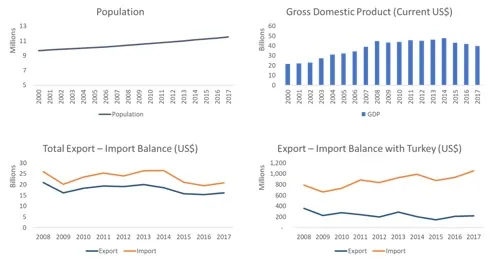
The Republic of Tunisia is located in North Africa and it is bordered by Algeria and Libya. The population of Tunisia is 11 million and its GDP is $40 Billion. Tunisia is a member state of the United Nations, La Francophonie, the Union for the Mediterranean, the Common Market for Eastern and Southern Africa, the Arab Maghreb Union, the Arab League, the OIC, the Greater Arab Free Trade Area, the Community of Sahel-Saharan States, the African Union and the Non-Aligned Movement.
Tunisia gained independence from France in 1956 and republic was declared in 1957. Arabic is the official language, and French and Berber are widely spoken. Its capital city is Tunis with approximately 10 million population. The Tunisian Revolution in 2011 caused the economy to slow down, however the country maintained parliamentary system.
Tunisia’s main import and export partner is France. Italy and Germany have also strong commercial relations. Tunisia does not have rich mineral resources and its economy relies on machinery production and textiles industry.
Tunisia and Turkey have historical and cultural relations. Turkish companies have strong presence in Tunisia both in exports and foreign direct investments. For example, TAV Airports is entitled to operate Enfidha-Hammamet Airport in Tunisia until May 2047. There are als other notable construction and textiles companies in the region.
Below, you can see the fact sheet, macroeconomic outlook and trade relations of Tunisia with Turkey.
Share this page with your network
Share on facebook Facebook Share on twitter Twitter Share on linkedin LinkedIn Share on whatsapp WhatsApp
Country at a glance
- Capital city
- Tunis
- Official language
- Arabic
- Population
- 11 million
- GDP
- $40 billion
- GDP per capita
- $3,491
- Human Development Index
- 0.735
- Top 3 import partners
- France, Italy, China
- Top 3 export partners
- France, Italy, Germany
- Top 3 import products
- Refined Petroleum, Cars, Petroleum Gas
- Top 3 export products
- Insulated Wire, Clothing, Crude Petroleum
- Trade balance
- -$4.7B in net imports
Source: Istanbul Africa Trade Company, Africa Economic Report (2019). Figures as published, reflecting data to 2017.
Turkey's exports to this market
Source: Istanbul Africa Trade Company, Africa Economic Report. Figures as published.
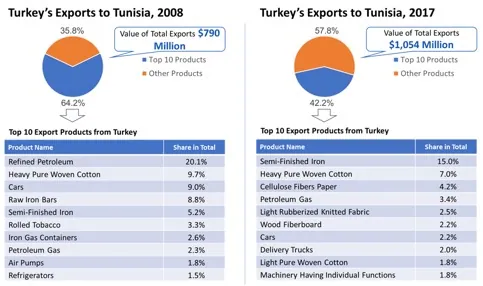
2008
$790 million
Top 10 products account for 64.2% of the total.
| Product | Share of total |
|---|---|
| Refined Petroleum | 20.1% |
| Heavy Pure Woven Cotton | 9.7% |
| Cars | 9% |
| Raw Iron Bars | 8.8% |
| Semi-Finished Iron | 5.2% |
| Rolled Tobacco | 3.3% |
| Iron Gas Containers | 2.6% |
| Petroleum Gas | 2.3% |
| Air Pumps | 1.8% |
| Refrigerators | 1.5% |
2017
$1,054 million
Top 10 products account for 42.2% of the total.
| Product | Share of total |
|---|---|
| Semi-Finished Iron | 15% |
| Heavy Pure Woven Cotton | 7% |
| Cellulose Fibers Paper | 4.2% |
| Petroleum Gas | 3.4% |
| Light Rubberized Knitted Fabric | 2.5% |
| Wood Fiberboard | 2.2% |
| Cars | 2.2% |
| Delivery Trucks | 2% |
| Light Pure Woven Cotton | 1.8% |
| Machinery Having Individual Functions | 1.8% |
Frequently asked questions
- Tunisia: what does Turkey export there?
- In 2017, Turkey's exports to this market were valued at $1,054 million. The ten largest product groups made up 42.2% of that total, led by Semi-Finished Iron; Heavy Pure Woven Cotton; Cellulose Fibers Paper.
- Tunisia: who are its main trading partners?
- The three largest import partners are France, Italy, China. The three largest export partners are France, Italy, Germany.
- Tunisia: what does the country import?
- The three largest import products are Refined Petroleum; Cars; Petroleum Gas. The three largest export products are Insulated Wire; Clothing; Crude Petroleum.
- Tunisia: how big is the economy?
- Population 11 million, GDP $40 billion, and $3,491 per person. The Human Development Index is 0.735.
- Tunisia: does it run a trade surplus or a deficit?
- The trade balance is -$4.7B in net imports.
Related reading
Tunisia Turkey Business and Trade 2026
In 2026, the landscape of Tunisia Turkey trade is set to transform significantly.
Exporting Chemicals to Africa
As global markets continue to expand and diversify, exporting chemicals to Africa has emerged as a lucrative and strategic opportunity for businesses...
Navigating African Trade Networks
As global trade continues to evolve, understanding and leveraging African trade networks has become increasingly critical for businesses aiming to...
Other country profiles
Reviewed by Burak Unal, Director of African Markets