Verifying an African Mineral Supplier Before You Pay
Verifying an African mineral supplier before you pay is simpler than it looks: confirm the company, the licence and the material, and tie every...
· 11 min read
Written by Burak Unal, Director of African Markets
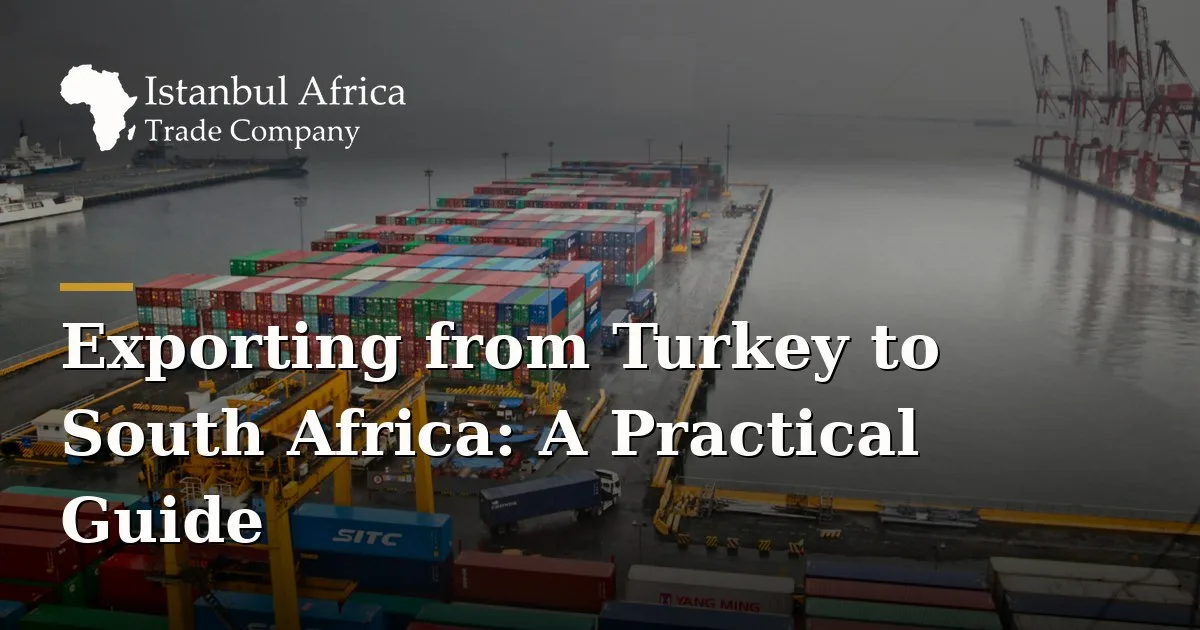
Exporting from Turkey to South Africa is a defined process, and this guide walks you through it from a first enquiry to a shipment that is ready to clear at the far end. By the time you finish reading you will know which documents a South African buyer expects, how customs clearance in South Africa is organised, roughly how long the process takes, and which decisions belong to the authorities rather than to you or your customer.
South Africa is one of the more developed markets on the continent, with an established import system and demanding product standards. That is good news for a serious exporter, because buyers there are used to structured paperwork and reliable supply. It also means shortcuts do not work. Getting the classification, the documents and the compliance right the first time is what separates a repeat customer from a one order experiment. If you want the country context before you commit, our South Africa country profile sets out the basics.
In our experience advising exporters, the week that goes wrong is almost never the shipping week. It is the week before, when a product code is guessed instead of confirmed, or a certificate is left until the goods are already sitting at the port. This guide is built to help you avoid that, whether you are a manufacturer in Bursa looking at your first container or a trader in Istanbul adding a new route.
Exporting from Turkey to South Africa involves five linked steps: agreeing terms with a buyer, classifying your goods, preparing the export and import documents, arranging transport, and clearing customs on arrival. Each step depends on the one before it, so the order matters as much as the content.
None of these steps is where we move your cargo or clear your goods. We advise on how to get each one right; the carrier moves the container and the authorities decide the clearance. Our import and export consulting service exists to sit alongside you through this sequence.
Turkish exporters already ship a broad range of manufactured goods into the South African market, led by refined fuels, vehicles and vehicle parts. This tells you the route is proven and the buyers are there; it does not tell you your specific product will sell, which is a separate question of price, quality and demand.
As of 2017, the last year covered by our Africa Economic Report (published 2019, with figures as of 2017), Turkey's exports to South Africa were worth around $607 million, down from about $1,327 million in 2008. Within that 2017 total, refined petroleum made up roughly 14.5 percent, cars about 7.8 percent, rubber tires around 4.7 percent and vehicle parts about 3.4 percent.
These are dated figures and Turkey South Africa trade moves year to year, so treat them as direction rather than a current reading. Check a live source such as TurkStat or South African customs data before you plan volumes.
The wider picture also matters. As of 2017, South Africa had a population of about 57 million and a GDP of roughly $350 billion, according to the same report, which makes it a substantial consumer and industrial market by African standards. Its largest import partners were China, Germany and the United States.
A Turkish supplier is therefore competing on quality and delivery, not just price, and that is where sound Turkey South Africa trade planning earns its keep. If you are still choosing what to sell, our sector and product investigation service researches demand before you commit to a shipment, and our African sector guides show where the openings tend to be.
The core export documents for South Africa are the commercial invoice, the packing list, the bill of lading, and a certificate of origin, plus any product specific certificates your goods require. Missing or inconsistent paperwork is the single most common reason a shipment is held, so the documents have to agree with each other exactly.
The usual set breaks down like this:
A point worth stressing: the export documents for South Africa must be internally consistent. If the invoice says one HS code and the certificate of origin implies another, the goods can be stopped while the difference is resolved. In our experience the classification code is where most first time exporters lose a week, because they discover at the port that the code they used changes the certificate they needed.
Customs clearance in South Africa is handled by the South African Revenue Service (SARS), which assesses the documents, calculates the duty and VAT, and releases the goods. In practice the importer or their licensed clearing agent lodges the declaration, not the overseas exporter, so your job is to give the buyer flawless documents to lodge.
Duty depends on the HS code and the customs value, and South Africa applies import VAT on top of duty. Some goods also need permits or must meet a compulsory standard before they are allowed in, which is checked at clearance.
Because customs clearance in South Africa turns on the tariff classification, confirming the HS code early is the highest value thing you can do, and it is a decision the customs authority ultimately owns, not the exporter. We can help you prepare and sense check the file, but SARS decides the duty and the release.
Note that Turkey and South Africa do not share a bilateral free trade agreement in the way Turkey does with some markets, so do not assume a preferential rate. Confirm the applicable tariff for your specific product with SARS or a licensed clearing agent before you quote a landed price to your buyer.
To start exporting from Turkey to South Africa, register as an exporter in Turkey, join the relevant exporters' association, confirm your product's HS code, and line up a buyer and a freight route before you produce anything to ship. Doing these in the right order stops you making goods you cannot yet move or sell.
A workable sequence looks like this:
Verifying the buyer belongs early on that list, not late. Confirming that a counterparty is real, solvent and who they say they are protects your first shipment far more than any discount you might negotiate. Our trade strategy development service helps you choose the entry route and the terms before money changes hands.
The honest answer is that the cost depends on your product, your volume and the freight market at the time of writing, so no single figure is meaningful in advance. Sea freight rates, insurance, duty and local charges all move, and a rate quoted this quarter can be wrong the next.
What you can plan around is the shape of the cost and the timeline. Sea freight from a Turkish port to Durban or Cape Town takes a number of weeks in transit, and clearance adds days on top depending on how clean the file is. The controllable variable is your paperwork: a complete, consistent document set clears faster than one that triggers a query.
Budget for the goods, the freight, insurance, duty and VAT, and the buyer's clearing agent fee, and get a live quote for each from a licensed provider rather than relying on a rule of thumb. We do not quote freight or duty ourselves, because those numbers belong to the carriers and the authorities, but you can speak to our advisors about structuring the file that keeps those costs predictable.
Exporting from Turkey to South Africa rewards preparation over speed. Get the classification confirmed, the documents consistent and the buyer verified, and the shipping and customs steps become routine rather than a scramble. That is the whole point of treating the route as a process: the parts that go wrong are predictable, and every one of them can be handled before the container leaves the port.
Istanbul Africa Trade Company is a trade consultancy based in Istanbul that has helped businesses in Turkey and across Africa find suppliers, verify partners and build trade routes since 2018. We advise on import and export consulting, sector and product investigation, contract manufacturing, and trade strategy development. To talk through your own plans, call or message us on WhatsApp at +90 532 669 30 50, email contact@istanbulafrica.com, or visit us at Merkez Mahallesi Hasat Sokak No:12a, 34384 Şişli/İstanbul. Contact us for guidance on your next shipment or sourcing decision.
You, as the exporter, do not obtain a South African import licence; that responsibility sits with your buyer or importer of record in South Africa. Certain product categories do require permits or must meet a compulsory standard, and those are arranged and held on the South African side. Confirm the requirements for your specific goods with the relevant regulator before you ship.
Sea freight is the normal method and takes several weeks in transit, with the exact time depending on the ports, the routing and the sailing schedule. Customs clearance adds further days once the goods arrive. Ask your licensed freight forwarder for a current transit time, since schedules and rates change.
There is no broad bilateral free trade agreement that gives Turkish goods an automatic preferential duty rate in South Africa. You should assume the standard tariff applies to your product and confirm the exact rate with the South African Revenue Service or a licensed clearing agent. Do not build a preferential rate into your pricing without checking it.
The South African Revenue Service decides the duty, based on the HS classification and the customs value of your goods. We can help you prepare and check the documents that support the classification, but the duty rate and the release of the goods are decisions for the customs authority, not for us or for your buyer.
Inconsistent documents are the most common reason, usually a mismatch between the HS code on the invoice and the details on the certificate of origin or a product certificate. Confirming the classification early and making every document agree with it prevents most delays. This is exactly the kind of file we help exporters get right before the goods move.
Istanbul Africa Trade Company is a trade consultancy based in Sisli, Istanbul, founded in 2018. We work with importers, exporters, manufacturers and distributors in Turkey and across 20 African markets, with market leaders on the ground in Ghana, Uganda and Zimbabwe. Our services cover import and export consulting, sector and product investigation, contract manufacturing, and trade strategy development. You can browse our African country profiles and sector guides on our site, or reach our advisors at contact@istanbulafrica.com and +90 532 669 30 50.
Istanbul Africa Trade Company provides trade consulting services only. We are not a freight forwarder, a customs broker, a shipping line, a bank, a law firm, a government agency or a certification body. We do not move cargo, clear goods, finance trade, or issue permits, licences or certificates. Tariff, customs, certification and regulatory decisions belong to the authorities of the countries involved. This article is general information, current as of the time it was written. Rules, tariffs and costs change, so confirm the details for your own case with the relevant authority or with our advisors before you act on them.
Verifying an African mineral supplier before you pay is simpler than it looks: confirm the company, the licence and the material, and tie every...
A practical guide to importing timber from Africa: the hardwood species worth buying, how to verify suppliers, the documents required, and the real...
A practical guide to importing cotton from Africa for Turkish textile mills: where to source raw lint, how to verify sellers, and the documents a...