Turkish Construction Materials in Africa: A Seller's Guide
A practical look at selling Turkish construction materials in Africa: the products that sell, the markets that buy them, what the 2017 trade data...
· 10 min read
Written by Burak Unal, Director of African Markets
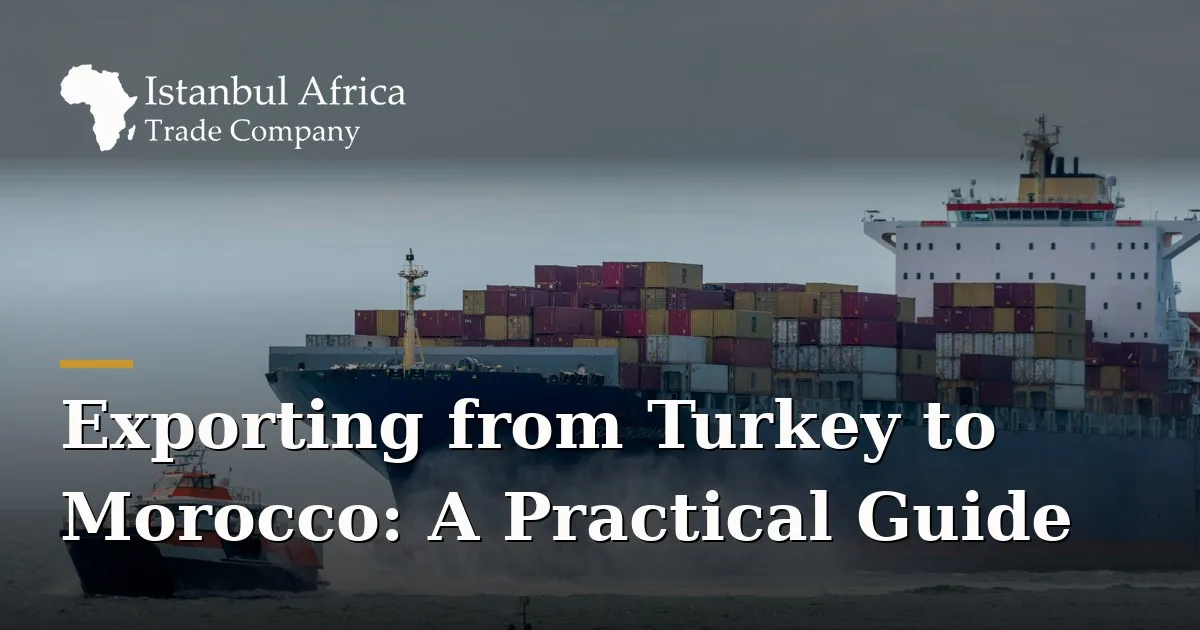
Exporting from Turkey to Morocco is a practical, well travelled route, and this guide walks you through what a first shipment actually takes, from the opening quotation to the moment your buyer collects the goods. By the end you will know which documents to prepare, who decides what along the way, and where first time exporters most often lose time. It is written for a Turkish manufacturer or exporter looking west across the Mediterranean, and for a Moroccan importer weighing up Turkish supply.
Morocco sits close to Turkey by sea, and the two countries have a long standing trade relationship, which is part of why this corridor has grown. As of 2017, the last year covered by our Africa Economic Report, published in 2019, Turkey's exports to Morocco were worth around $1,646 million, up from roughly $1,096 million in 2008. Those figures are old, and trade has moved since, so treat them as direction rather than a live number, and confirm the current total with an official source before you quote it anywhere.
The sections below are the questions exporters ask us, in the order they tend to ask them. Read them in sequence for a first shipment, or jump to the one that is blocking you now.
Exporting from Turkey to Morocco involves five stages in a fixed order: agreeing commercial terms with a buyer, classifying your goods, preparing the export documents, arranging carriage by sea or air, and presenting the goods for customs clearance into Morocco. Each stage has a clear owner, and knowing who owns which decision is half the work.
Our role sits around these stages as an adviser. We help you plan the route, get the classification right and assemble the file, through our import and export consulting service. We do not move the cargo or clear it, and no consultant can promise how the authorities will rule.
A wide range of Turkish manufactured goods already sell into Morocco, led by vehicles, engines, iron and steel products and textiles. The trade data gives a useful picture of what the market has actually absorbed. As of 2017, the last year covered by our Africa Economic Report, published in 2019, these were the ten largest Turkish export products to Morocco by share of the total.
| Product (2017) | Share of Turkey's exports to Morocco |
|---|---|
| Cars | 9.7% |
| Spark-Ignition Engines | 5.0% |
| Iron Blocks | 4.0% |
| Delivery Trucks | 3.2% |
| Jewellery | 3.1% |
| Heavy Pure Woven Cotton | 2.5% |
| Vehicle Parts | 2.5% |
| Refrigerators | 2.5% |
| Hand-Woven Rugs | 2.0% |
| Rubber Tires | 2.0% |
Textiles run through that list, from woven cotton to finished rugs, which is why Turkish suppliers in fabric and clothing look hard at this market. If you are weighing which line to lead with, our textile sector guide and our Morocco country profile set out the wider context. Whether a specific product will sell is a question of price, quality and demand, so it is worth testing before you commit a container of Turkish products in Morocco. Before you build a plan around any of these categories, remember the shares are from 2017 and the mix will have shifted since.
The core export documents for Morocco are the commercial invoice, the packing list, a certificate of origin, the transport document, and any product specific certificates your goods require. These travel as a set, and a mismatch between them is the single most common cause of a hold at the border.
In our experience the classification code is where most first time exporters lose a week, because the wrong code pulls the wrong document list and the error only surfaces at the border. We help you get the export documents for Morocco assembled and consistent, but the certificates themselves are issued by chambers, laboratories and authorities, never by us.
Most goods on the Turkey Morocco trade route move by sea, in containers, from Turkish ports to the main Moroccan ports on the Atlantic and the Mediterranean. Sea freight is the default because it carries volume at a workable cost, while air is reserved for urgent or high value, low weight consignments.
Shipping goods to Morocco by sea usually means a container from a port such as Istanbul, Izmir or Mersin to a Moroccan gateway, with transit times that vary by routing and season. A freight forwarder arranges the booking, the loading and the bill of lading; we are not that forwarder, and we do not quote freight. What we do is help you read the quotes you receive and choose Incoterms that put the right risk in the right place.
The cost of shipping goods to Morocco depends on volume, lane and season, so gather more than one quote before you decide. Getting Incoterms wrong is the second classic mistake: agree to deliver further than you can control, and a delay you did not cause becomes your problem. Planning the Turkey Morocco trade route well means deciding, in advance, where your responsibility ends and the buyer's begins.
Customs clearance in Morocco is handled by Moroccan customs and the buyer's appointed customs broker, and it is their decision, not the exporter's. When the goods arrive, the import file is lodged, the tariff code is checked, duty and taxes are assessed, and the goods are released, held for inspection or queried. As the exporter, your influence is upstream: a clean, consistent document set makes the clearance smoother, but you cannot promise it and neither can we.
Duty depends on the tariff code and on whether the goods qualify for preferential treatment under the trade agreement between Turkey and Morocco. Rates and rules change, and they are set by the authorities, so confirm the current treatment for your specific product before you price the deal. If tariffs and market entry are central to your plan, our trade strategy development service is built to think that through with you, without ever standing in for the customs authority that makes the call.
You find a buyer in Morocco the same way you would anywhere: through targeted research, trade contacts and checks, and then you verify them before you ship on open terms. A promising order from an unverified counterparty is a risk, not a win, and the checks are cheaper than the loss. This is where a Turkish exporter new to the market benefits most from local knowledge.
Our sector and product investigation service exists for exactly this: finding real buyers for Turkish products in Morocco, confirming that a company is what it says it is, and reporting on demand and price before you commit. In our experience the buyers who move fastest are the ones who send a written specification up front, because it lets both sides price and plan against the same facts. Selling Turkish products in Morocco is easier when you begin with a shortlist you trust rather than a single unchecked contact. We advise and verify; the commercial decision, and the deal itself, stay with you and your buyer.
Exporting from Turkey to Morocco rewards preparation: settle terms in writing, classify the goods correctly, assemble a consistent document file, plan the sea route and the Incoterms, and verify your buyer before you ship. Do that, and the border becomes a checkpoint rather than a wall. Where you want a second pair of eyes on any stage, that is the work we do.
Istanbul Africa Trade Company is a trade consultancy based in Istanbul that has helped businesses in Turkey and across Africa find suppliers, verify partners and build trade routes since 2018. We advise on import and export consulting, sector and product investigation, contract manufacturing, and trade strategy development. To talk through your own plans, call or message us on WhatsApp at +90 532 669 30 50, email contact@istanbulafrica.com, or visit us at Merkez Mahallesi Hasat Sokak No:12a, 34384 Şişli/İstanbul. Contact us for guidance on your next shipment or sourcing decision.
Turkey and Morocco have a trade agreement that can give qualifying goods preferential duty treatment, but its terms have changed over time. Whether your specific product qualifies, and at what rate, is decided by the customs authorities, so confirm the current position before you price a deal.
Sea transit times vary by port pairing, routing and season, so there is no single number that holds. Ask your freight forwarder for a current transit time on your exact lane, and build a margin into any date you promise your buyer.
The importer of record in Morocco, usually your buyer, pays the duty and import taxes assessed by Moroccan customs. The exact amount depends on the tariff code and any preferential treatment, both of which the authorities decide.
In most cases yes, and it is issued by an authorised Turkish chamber of commerce, not by a consultancy. A separate movement or preference certificate may also help if your goods qualify under the trade agreement, but that is a decision for customs.
No. We are a trade consultancy, not a customs broker or freight forwarder, so we do not clear goods or move cargo. We help you plan the route, get the classification and documents right, and verify your buyer, while the authorities and your appointed broker handle clearance.
Istanbul Africa Trade Company is a trade consultancy based in Sisli, Istanbul, founded in 2018. We work with importers, exporters, manufacturers and distributors in Turkey and across 20 African markets, with market leaders on the ground in Ghana, Uganda and Zimbabwe. Our services cover import and export consulting, sector and product investigation, contract manufacturing, and trade strategy development. You can browse our African country profiles and sector guides on our site, or reach our advisors at contact@istanbulafrica.com and +90 532 669 30 50.
Istanbul Africa Trade Company provides trade consulting services only. We are not a freight forwarder, a customs broker, a shipping line, a bank, a law firm, a government agency or a certification body. We do not move cargo, clear goods, finance trade, or issue permits, licences or certificates. Tariff, customs, certification and regulatory decisions belong to the authorities of the countries involved. This article is general information, current as of the time it was written. Rules, tariffs and costs change, so confirm the details for your own case with the relevant authority or with our advisors before you act on them.
A practical look at selling Turkish construction materials in Africa: the products that sell, the markets that buy them, what the 2017 trade data...
Verifying an African mineral supplier before you pay is simpler than it looks: confirm the company, the licence and the material, and tie every...
A practical guide to importing timber from Africa: the hardwood species worth buying, how to verify suppliers, the documents required, and the real...