Turkish Construction Materials in Africa: A Seller's Guide
A practical look at selling Turkish construction materials in Africa: the products that sell, the markets that buy them, what the 2017 trade data...
· · 9 min read
Written by Burak Unal, Director of African Markets
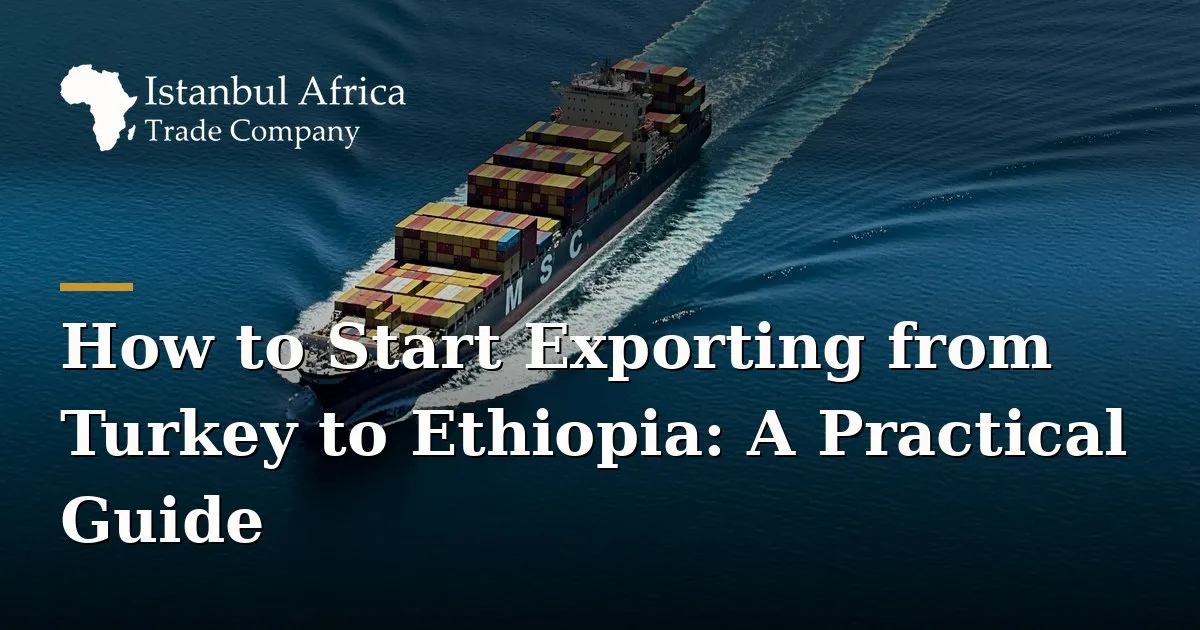
Exporting from Turkey to Ethiopia rewards preparation, and this guide walks you through the whole route: the documents you produce, the order they come in, the Ethiopian rules that decide what lands, and who along the way actually makes each decision. By the end you should be able to plan a first shipment without guessing.
Ethiopia is one of the larger economies in East Africa and a market Turkish manufacturers have supplied for years. As of 2017, the last year our Africa Economic Report covers, its population was around 105 million and its GDP about $81 billion, with GDP per capita near $768. Those figures are old, so treat them as direction rather than a current reading, and confirm today's numbers before you commit.
We advise on this route rather than run it. The company does not move your cargo or clear it at the border; it helps you get the paperwork, the classification and the buyer relationship right so the parties who do move and clear goods have less to argue about. In our experience the Turkey Ethiopia trade route trips up first time exporters at the classification code and the pre-shipment inspection, not at the port.
Exporting from Turkey to Ethiopia involves five stages: agreeing terms with a buyer, classifying and pricing the goods, producing the export documents, arranging carriage and insurance, and meeting Ethiopia's import controls at the far end. Each stage has its own decision maker, and confusing them is where money and time leak. You draft the commercial invoice; the Ethiopian authorities decide duty; a carrier, not you, sets sailing dates.
Most of the work sits at the front. A clear contract that names the Incoterm, the currency and the inspection basis removes most of the disputes that surface later. Our sector and product research work often starts here, confirming that a product and a price make sense in the destination market before a single box is packed.
The core export documents for Ethiopia are a commercial invoice, a packing list, a bill of lading or air waybill, a certificate of origin, and any product certificates the goods require. The exporter prepares the invoice and packing list; a Turkish chamber of commerce issues and stamps the certificate of origin; the carrier issues the transport document. Ethiopia also typically requires a pre-shipment or destination inspection, which we cover below.
Get the export documents for Ethiopia consistent with each other before anything ships. The product description, quantities, weights and values must match across the invoice, the packing list and the transport document, because Ethiopian customs reads them side by side. In our experience a mismatch of a few kilograms between the packing list and the bill of lading is enough to hold a container while it is queried.
Ethiopian import requirements shape your shipment from the contract stage, because the country operates foreign exchange controls and a pre shipment inspection regime that both start before the goods leave Turkey. An importer in Ethiopia generally needs a bank permit and an import licence, and the goods may need a conformity inspection before loading. These are decisions for Ethiopian banks and authorities, not for you or for us.
Plan around the foreign exchange step in particular. Ethiopian import requirements have long included a letter of credit framework administered through the National Bank of Ethiopia, and your buyer's ability to open and fund that credit can set your real timeline. Confirm the current rules with the National Bank of Ethiopia or a licensed bank before you promise a date, since these controls change.
Turkey sells Ethiopia mostly industrial and construction inputs, led by iron and steel products. As of 2017, the last year our Africa Economic Report covers, trade from Turkey to Ethiopia was worth about $338 million, up from around $199 million in 2008, and raw iron bars alone were close to 24 percent of the Turkish side that year. The rest spread across iron structures, plastic pipes, copper wire and packaged medicaments.
| Top Turkish exports to Ethiopia, 2017 | Share of the Turkey to Ethiopia total |
|---|---|
| Raw iron bars | 24.0% |
| Iron structures | 5.5% |
| Toilet paper | 4.8% |
| Plastic pipes | 4.3% |
| Copper wire | 3.0% |
Those shares are from our 2019 Africa Economic Report and describe 2017, so read them as the shape of the trade rather than this year's numbers. Ethiopia's own top exports then were coffee, oily seeds and gold, and its largest import partners were China, France and India. If your product sits outside the established list, that is a reason to investigate, not a reason to abandon the Turkey Ethiopia trade route.
Shipping goods to Ethiopia usually means a sea leg to Djibouti followed by an inland haul to Addis Ababa, because Ethiopia is landlocked and most of its ocean freight clears through the port of Djibouti. That transit and the border crossing add time that a direct port to port estimate hides. Air freight is faster and is common for high value or urgent goods such as pharmaceuticals and spare parts.
Budget for the Djibouti corridor when shipping goods to Ethiopia, not just the sea days. The handoff between the maritime carrier, the Djibouti port and the road or rail movement to Addis Ababa is where schedules slip, and it is outside your control and ours. A freight forwarder quotes and runs this leg; our role is to make sure your documents survive the extra handling without a query. Our Ethiopia shipping and customs walkthrough covers this leg in more depth.
You find a buyer in Ethiopia the same way you would in any unfamiliar market: through sector research, trade bodies and introductions, and then you verify them before you ship on open terms. Checking that a counterpart is a real, licensed importer with the bank standing to pay is worth more than any single sales lead. This verification is exactly the kind of groundwork we do for clients entering the market.
A country read is a sensible first step before you commit. Our Ethiopia country profile gives you the market context, and comparing this corridor with a neighbouring one helps too, since the lessons from exporting to another North African market such as Egypt often transfer to the East African route.
Exporting from Turkey to Ethiopia comes down to sequencing: settle terms, classify and price, produce consistent documents, plan the Djibouti corridor, and meet Ethiopia's inspection and foreign exchange rules before you load. None of it needs to be improvised. Our import and export consulting exists to keep that sequence in order, and you can reach us to talk through your own shipment whenever you are ready.
Istanbul Africa Trade Company is a trade consultancy based in Istanbul that has helped businesses in Turkey and across Africa find suppliers, verify partners and build trade routes since 2018. We advise on import and export consulting, sector and product investigation, contract manufacturing, and trade strategy development. To talk through your own plans, call or message us on WhatsApp at +90 532 669 30 50, email contact@istanbulafrica.com, or visit us at Merkez Mahallesi Hasat Sokak No:12a, 34384 Şişli/İstanbul. Contact us for guidance on your next shipment or sourcing decision.
Your Ethiopian buyer generally needs the import licence and the bank permit, not you as the Turkish exporter. Ethiopia's import and foreign exchange controls sit on the buyer's side, so confirm your counterpart holds a valid licence before you ship. The licence itself is issued by the Ethiopian authorities, not by any consultancy.
No. We are a trade consultancy and we do not clear goods, move cargo or issue any certificate. We help you prepare and check the documents and the buyer relationship, while a licensed customs broker and a freight forwarder handle clearance and carriage.
Ethiopia is landlocked, so most of its ocean freight is handled at the port of Djibouti and then moved inland to Addis Ababa by road or rail. This adds a border crossing and a handoff that a port to port transit time does not show, so plan for it.
They are from our Africa Economic Report and describe 2017, the last year it covers. Treat them as the shape and direction of the Turkey to Ethiopia trade rather than this year's numbers, and confirm current figures before you rely on them.
A certificate of origin states where goods were produced, and for Turkish exports it is issued and stamped by a Turkish chamber of commerce. You prepare the supporting details, but the chamber issues the document; a consultancy cannot issue it for you.
Istanbul Africa Trade Company is a trade consultancy based in Sisli, Istanbul, founded in 2018. We work with importers, exporters, manufacturers and distributors in Turkey and across 20 African markets, with market leaders on the ground in Ghana, Uganda and Zimbabwe. Our services cover import and export consulting, sector and product investigation, contract manufacturing, and trade strategy development. You can browse our African country profiles and sector guides on our site, or reach our advisors at contact@istanbulafrica.com and +90 532 669 30 50.
Istanbul Africa Trade Company provides trade consulting services only. We are not a freight forwarder, a customs broker, a shipping line, a bank, a law firm, a government agency or a certification body. We do not move cargo, clear goods, finance trade, or issue permits, licences or certificates. Tariff, customs, certification and regulatory decisions belong to the authorities of the countries involved. This article is general information, current as of the time it was written. Rules, tariffs and costs change, so confirm the details for your own case with the relevant authority or with our advisors before you act on them.
A practical look at selling Turkish construction materials in Africa: the products that sell, the markets that buy them, what the 2017 trade data...
Verifying an African mineral supplier before you pay is simpler than it looks: confirm the company, the licence and the material, and tie every...
A practical guide to importing timber from Africa: the hardwood species worth buying, how to verify suppliers, the documents required, and the real...