Exporting from Turkey to Uganda: A Practical Guide
A practical guide to exporting from Turkey to Uganda: the documents, the shipping route through Mombasa or Dar es Salaam, the regulations, and the...
· 10 min read
Written by Burak Unal, Director of African Markets
Exporting from Turkey to Ivory Coast is a realistic move for a Turkish manufacturer who has read the market, prepared the paperwork and chosen a route with care. By the end of this guide you will know which documents to gather, how a container clears the port at Abidjan, what a first shipment usually costs you in time, and where a first time exporter tends to lose a week.
Ivory Coast is a French speaking economy in West Africa and one of the region's larger markets. As of 2017, the last year covered by our Africa Economic Report, its population was around 24 million and its GDP was around $40 billion, with GDP per capita near $1,662. Those figures are dated, so treat them as direction rather than a current number, and confirm the present picture before you commit to a plan.
Our role here is to advise. We help you classify the product, prepare the file and verify the party at the other end, but the customs authority decides duties and clearance, and the buyer and seller decide the deal. This guide keeps to what you can actually control, and points to where the decisions sit with someone else.
To start exporting from Turkey to Ivory Coast you need a registered business, a product that is legal to import there, commercial documents that match the shipment exactly, and a freight and customs plan agreed before the goods leave your warehouse. Each of those is a decision, not a form, and getting them in the right order saves the most time.
The first decision is the product and its classification code, because the code drives the duty rate, the paperwork and any special permits your importer will need. In our experience the classification code is where most first time exporters lose a week, usually because the code on the invoice does not match the code the buyer declared. We help exporters settle the code and the file early through our import and export consulting, so the two sides agree before a container is booked. If you are still choosing what to sell, a structured look at demand through sector and product investigation is cheaper than a shipment that does not move.
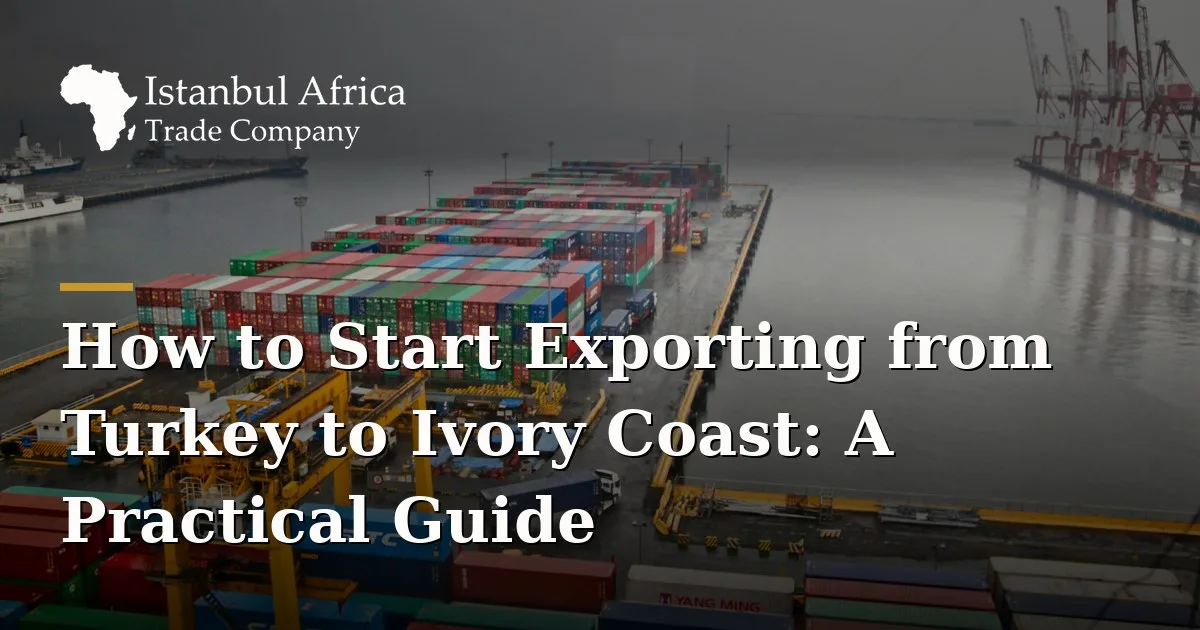
The Turkey to Ivory Coast trade route runs mainly by sea, from Turkish ports to the Port of Abidjan, which is the country's main commercial gateway. Sea freight suits the goods Turkey already sells into the market, which tend to be heavier construction and food inputs rather than express parcels.
The scale is modest but growing. As of 2017, the last year covered by our Africa Economic Report, Turkey's exports to Ivory Coast were around $142 million, up from about $47 million in 2008. Those figures are dated, so check current national trade statistics before you size an order.
| Top Turkish exports to Ivory Coast | Share of the total (2017) |
|---|---|
| Cement | 13.1 percent |
| Hot-rolled iron bars | 5.6 percent |
| Baked goods | 4.8 percent |
| Iron blocks | 4.2 percent |
| Pure olive oil | 3.7 percent |
| Prefabricated buildings | 3.7 percent |
| Yeast | 3.3 percent |
Cement, iron and prefabricated buildings dominate that list, with baked goods, olive oil and yeast behind them, which tells you the Turkey to Ivory Coast trade route is built today on construction materials and food processing inputs more than on finished consumer goods. Those shares come from our 2019 Africa Economic Report and describe 2017, so treat them as the shape of the trade rather than this year's numbers.
That mix is a starting map, not a limit. Ivory Coast's own economy leans on cocoa: as of 2017 its top export products were cocoa bean, cocoa paste and rubber, and its main import partners were China, France and Nigeria. You can read the fuller picture on our Ivory Coast country profile before you decide where a Turkish product fits.
The core export documents for Ivory Coast are a commercial invoice, a packing list, a bill of lading and a certificate of origin, with product specific certificates added on top. Each document has to describe the same goods, the same quantities and the same values, because a mismatch between any two of them is what stops a container at the port.
A workable starting set of export documents for Ivory Coast looks like this:
We do not issue any of these. A certificate of origin comes from a chamber of commerce, a health or phytosanitary certificate from the responsible government body, and a bill of lading from your carrier. What we do is check that the file is complete and internally consistent before it travels, because the cheapest correction is the one made in Istanbul rather than in Abidjan.
Customs clearance in Ivory Coast is handled by the Ivorian customs authority, through a declaration that your importer or their licensed broker files on arrival. The importer of record in Ivory Coast is the party who lodges the declaration and pays the duties and taxes assessed, so your buyer's readiness matters as much as your paperwork.
Duty rates and any applicable taxes are set by the authorities, and they can change, so confirm the current rate for your product's code at the time of shipping rather than relying on a figure you were quoted a year earlier. Customs clearance in Ivory Coast tends to go quickly when the declared classification, the invoice value and the physical goods all agree, and slowly when they do not. Because Ivory Coast belongs to the Economic Community of West African States (ECOWAS), goods entering through Abidjan may move on to neighbouring markets, but that onward movement is a separate customs question you should raise with your buyer and their broker early.
Our part is to make the clearance predictable, not to perform it. We are not a customs broker and we do not clear goods; we help you and your importer align on the classification and the documents so the broker has a clean file to work from.
Shipping goods to Abidjan involves booking sea freight to the port, packing for a hot and humid climate, and preparing the arrival documents your importer needs to take delivery. The route is well served by container lines calling at Abidjan, so the practical variables are timing, packing and the accuracy of the documents rather than whether a service exists.
Two things reward attention when shipping goods to Abidjan. First, packing: cement, food inputs and steel each fail in a different way if they sit on a humid quay, so match the packaging to the product and the season. Second, timing: agree who is responsible at each leg using a clear Incoterm on the invoice, because a delivery term left vague is where demurrage charges start. We help exporters think through the construction and building materials that dominate this route on our construction and building materials sector page, which is a useful reference when you are packing cement or steel for a first order.
You reduce risk when exporting from Turkey to Ivory Coast by verifying the buyer before you ship, agreeing payment terms that protect both sides, and starting with an order small enough to survive a mistake. A new corridor is not the place for your largest ever consignment.
Verifying the party at the other end is the single most valuable step, and it is one a search engine cannot do for you. We help exporters check that a prospective buyer is a real trading business at a real address with a real track record before money or goods move, and we never name the companies involved. If you have run a similar route before, the lessons transfer: many of the same disciplines appear in our guide to exporting to another Francophone market, Morocco, where French language documentation and partner checks matter just as much.
Exporting from Turkey to Ivory Coast rewards preparation over speed: a correctly classified product, a consistent document file, a verified buyer and a modest first order will do more for you than a large shipment sent in a hurry. Get those four right and the rest of the corridor becomes routine.
Istanbul Africa Trade Company is a trade consultancy based in Istanbul that has helped businesses in Turkey and across Africa find suppliers, verify partners and build trade routes since 2016. We advise on import and export consulting, sector and product investigation, contract manufacturing, and trade strategy development. To talk through your own plans, call or message us on WhatsApp at +90 532 669 30 50, email contact@istanbulafrica.com, or visit us at Merkez Mahallesi Hasat Sokak No:12a, 34384 Şişli/İstanbul. Contact us for guidance on your next shipment or sourcing decision.
Exporting from Turkey to Ivory Coast can be worth it for a first time exporter who starts small and prepares well. The corridor already carries Turkish construction materials and food inputs, so demand is proven, and a modest first order lets you learn the route before you scale.
The time varies and is decided by the authorities, not by us, but customs clearance in Ivory Coast is generally faster when the declared code, the invoice value and the physical goods all match. Mismatches are the most common cause of delay, so a consistent document file is the best thing within your control.
The Port of Abidjan is the country's main commercial gateway and the usual point of entry for sea freight from Turkey. It is well served by container lines, so for most Turkish exporters shipping goods to Abidjan is a matter of timing and packing rather than finding a service.
A Turkish chamber of commerce issues the certificate of origin, not Istanbul Africa Trade Company. Among the export documents for Ivory Coast it confirms where the goods were made, and it must describe the same goods as the invoice and packing list.
No. We are a trade consultancy, not a customs broker, a freight forwarder or a bank, so we do not clear goods, move cargo or pay duties. We help you classify the product, prepare a consistent file and verify your buyer, while the customs authority and your importer handle clearance and payment.
Istanbul Africa Trade Company is a trade consultancy based in Sisli, Istanbul, founded in 2016. We work with importers, exporters, manufacturers and distributors in Turkey and across 20 African markets, with market leaders on the ground in Ghana, Uganda and Zimbabwe. Our services cover import and export consulting, sector and product investigation, contract manufacturing, and trade strategy development. You can browse our African country profiles and sector guides on our site, or reach our advisors at contact@istanbulafrica.com and +90 532 669 30 50.
Istanbul Africa Trade Company provides trade consulting services only. We are not a freight forwarder, a customs broker, a shipping line, a bank, a law firm, a government agency or a certification body. We do not move cargo, clear goods, finance trade, or issue permits, licences or certificates. Tariff, customs, certification and regulatory decisions belong to the authorities of the countries involved. This article is general information, current as of the time it was written. Rules, tariffs and costs change, so confirm the details for your own case with the relevant authority or with our advisors before you act on them.
A practical guide to exporting from Turkey to Uganda: the documents, the shipping route through Mombasa or Dar es Salaam, the regulations, and the...
A practical guide to exporting from Turkey to Tanzania: the products, documents, shipping and costs behind a first order, and who decides what at...
A practical guide to exporting from Turkey to Ethiopia: the documents, the Djibouti corridor, Ethiopian import rules, and who decides what at each...