
Country Profiles
Egypt
 Egypt
Egypt is the third largest economy in Africa and it is located in the north part of the continent. Egypt has a population of around 100 million people and its GDP is $235 billion. Egypt has a strategic location and the Suez Canal is located in this country.
Egypt was part of the British Empire until it gained independence in 1922. Its official language is Arabic and capital city is Cairo. The population of Cairo is 20 million and the population of the second biggest city, Alexandria, is around 5 million. Egypt’s economic growth slowed down following the political events in 2011.
Egypt’s biggest import partner is China and they import diverse range of products from them. Egypt especially imports industrial products and food. Egypt mainly exports its products to Middle East, Turkey and Europe. Their exports are concentrated in petroleum, gold and textiles.
Turkey has more than $2 Billion direct investment in Egypt and Turkish companies employ more than 75,000 Egyptian employees. Main sectors of Turkish companies operating in Egypt are textiles, automotive and financial services. There are ongoing initiatives for opening a Turkish-Egyptian University and industrial zones. There are important opportunities in exporting consumer goods and industrial products.
Below, you can see the fact sheet, macroeconomic outlook and trade relations of Egypt with Turkey.
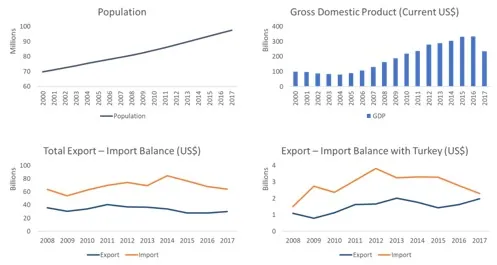
Country at a glance
- Capital city
- Cairo
- Official language
- Arabic
- Population
- 98 million
- GDP
- $235 billion
- GDP per capita
- $2,413
- Human Development Index
- 0.696
- Top 3 import partners
- China, Russia, Germany
- Top 3 export partners
- United Arab Emirates, Italy, Turkey
- Top 3 import products
- Refined Petroleum, Petroleum Gas, Wheat
- Top 3 export products
- Crude Petroleum, Gold, Fertilizers
- Trade balance
- -$34B in net imports
Source: Istanbul Africa Trade Company, Africa Economic Report (2019). Figures as published, reflecting data to 2017.
Egypt: practical trade guide
What a shipment between Turkey and this market needs, how the goods get there, and what to settle before you sign.
- Main ports
- Alexandria, Damietta, Port Said, Ain Sokhna
- Currency
- Egyptian pound (EGP)
- Trade blocs
- AfCFTA, COMESA, GAFTA
- Trade agreement with Turkey
- Free trade agreement in force: preferential duty on Turkish-origin goods with proof of origin
Specific to Egypt
- Advance Cargo Information (ACI): before shipment the Egyptian importer obtains an ACID number through the Nafeza single window, the Turkish exporter registers on CargoX to exchange documents, and the ACID must appear on the shipping documents. Without it the goods are not cleared.
- For a list of consumer goods, the foreign manufacturer must be registered with GOEIC before export.
Standard documents
- Commercial invoice and packing list
- Bill of lading or air waybill
- Certificate of origin issued by a Turkish chamber of commerce
- Insurance certificate when the Incoterm includes insurance (CIF, CIP)
- Proof of preferential origin (EUR.1 or an origin declaration) to claim the agreement rate
Before you sign
- Check the counterparty: registration, activity and references
- Match the payment structure to the risk: advance or partial payment, documentary collection or a letter of credit
- Confirm whether your product needs a certificate or registration in this market before production starts
Reviewed October 2026. Requirements change: confirm the current rules for your product with your forwarder, the buyer's customs broker or us before shipping.
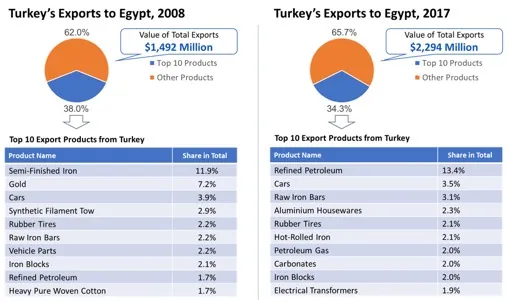
Turkey's exports to this market
Source: Istanbul Africa Trade Company, Africa Economic Report. Figures as published.
2008
$1,492 million
Top 10 products account for 38% of the total.
| Product | Share of total |
|---|---|
| Semi-Finished Iron | 11.9% |
| Gold | 7.2% |
| Cars | 3.9% |
| Synthetic Filament Tow | 2.9% |
| Rubber Tires | 2.2% |
| Raw Iron Bars | 2.2% |
| Vehicle Parts | 2.2% |
| Iron Blocks | 2.1% |
| Refined Petroleum | 1.7% |
| Heavy Pure Woven Cotton | 1.7% |
2017
$2,294 million
Top 10 products account for 34.3% of the total.
| Product | Share of total |
|---|---|
| Refined Petroleum | 13.4% |
| Cars | 3.5% |
| Raw Iron Bars | 3.1% |
| Aluminium Housewares | 2.3% |
| Rubber Tires | 2.1% |
| Hot-Rolled Iron | 2.1% |
| Petroleum Gas | 2% |
| Carbonates | 2% |
| Iron Blocks | 2% |
| Electrical Transformers | 1.9% |
Frequently asked questions
- Egypt: what does Turkey export there?
- In 2017, Turkey's exports to this market were valued at $2,294 million. The ten largest product groups made up 34.3% of that total, led by Refined Petroleum; Cars; Raw Iron Bars.
- Egypt: who are its main trading partners?
- The three largest import partners are China, Russia, Germany. The three largest export partners are United Arab Emirates, Italy, Turkey.
- Egypt: what does the country import?
- The three largest import products are Refined Petroleum; Petroleum Gas; Wheat. The three largest export products are Crude Petroleum; Gold; Fertilizers.
- Egypt: how big is the economy?
- Population 98 million, GDP $235 billion, and $2,413 per person. The Human Development Index is 0.696.
- Egypt: does it run a trade surplus or a deficit?
- The trade balance is -$34B in net imports.
- Egypt: which ports handle goods from Turkey?
- The main ports are Alexandria, Damietta, Port Said, Ain Sokhna.
- Egypt: what does a shipment from Turkey need beyond the standard documents?
- Advance Cargo Information (ACI): before shipment the Egyptian importer obtains an ACID number through the Nafeza single window, the Turkish exporter registers on CargoX to exchange documents, and the ACID must appear on the shipping documents. Without it the goods are not cleared. For a list of consumer goods, the foreign manufacturer must be registered with GOEIC before export.
- Egypt: do Turkish goods get a preferential duty rate?
- Yes. Turkey and Egypt have a free trade agreement in force, so qualifying Turkish-origin goods can enter at preferential rates when the shipment carries proof of origin.
Related reading
How to Start Exporting from Turkey to Egypt: A Practical Guide
A practical guide to exporting from Turkey to Egypt: choosing a product, verifying a buyer, preparing the documents and moving the goods, step by...
Turkey Egypt Trade Opportunities 2026
Turkey Egypt trade is on the brink of a transformative phase as we approach 2026.
Importing Cotton from Africa for Turkish Textile Mills
A practical guide to importing cotton from Africa for Turkish textile mills: where to source raw lint, how to verify sellers, and the documents a...
- How to Start Exporting from Turkey to Cameroon: A Practical Guide
- How to Start Exporting from Turkey to Algeria: A Practical Guide
- How to Start Exporting from Turkey to Ethiopia: A Practical Guide
- Exporting from Turkey to Kenya: A Practical Starter Guide
- Best African Countries for Turkish Exporters
- Exporting Home Appliances to Africa
- Exporting Fashion to Africa
- Top African Importers of Turkish Goods
- Understanding Trade Regulations in Africa
Other country profiles
- Buying from Turkey for Egypt?How we find and check Turkish manufacturers and secure your terms before you pay.For African importers
- Exporting from Turkey to Egypt?How to Start Exporting from Turkey to Egypt: A Practical GuideRead the route guide
Reviewed by Burak Unal, Director of African Markets